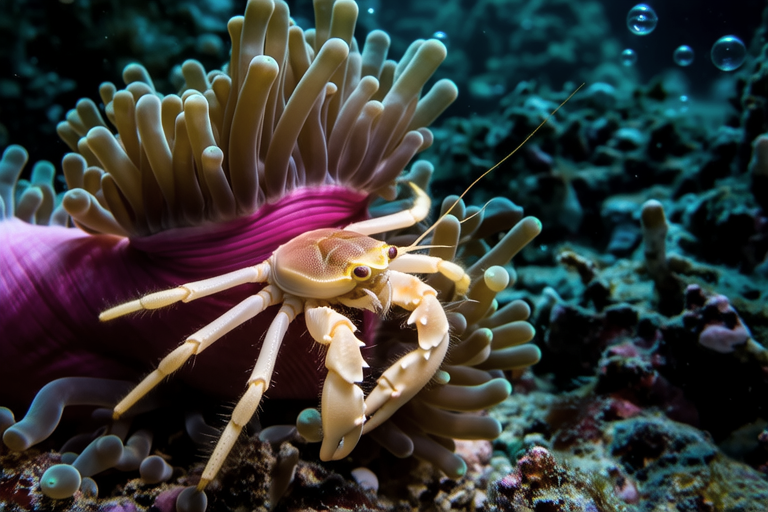
How Pea Crabs Survive Inside Sea Anemones and Clams
In the vast and mysterious world of marine biology, one of the most fascinating relationships exists between pea crabs and their hosts: sea anemones and clams. This symbiotic partnership is a testament to nature’s ingenuity and complexity. Pea crabs, belonging to the family Pinnotheridae, have evolved to live inside these larger organisms, adapting to their environment in ways that ensure their survival and contribute to the health of marine ecosystems.
The Symbiotic Relationship
The relationship between pea crabs and their hosts can be described as mutualistic, where both parties benefit from each other. For the pea crab, the host provides shelter, protection, and a source of food. In return, the pea crab offers some form of assistance to the host, although the exact nature of this help varies depending on the specific species of pea crab and its host.
Pea crabs living inside sea anemones, for example, may help to clean debris from the tentacles, thus improving the anemone’s ability to capture prey. Similarly, pea crabs within clams might assist in keeping the clam’s gills clear of detritus, enhancing the clam’s respiratory efficiency. These small contributions, while seemingly minor, can significantly impact the overall health and vitality of the host organism.
Adaptations for Survival
To thrive inside their hosts, pea crabs have developed several remarkable adaptations. Their size is a crucial factor; pea crabs are typically tiny, measuring just a few millimeters in length. This diminutive stature allows them to fit comfortably within the confines of their hosts without causing undue stress or harm.
Another notable adaptation is the pea crab’s flattened body shape, which enables it to maneuver easily within the limited space of the host. Additionally, pea crabs have highly flexible joints that allow them to contort their bodies to navigate through narrow passageways. These physical traits are essential for surviving within the often cramped and complex environments of sea anemones and clams.
Pea crabs also possess specialized appendages that aid in their survival. The claws of pea crabs are particularly adapted for gripping onto the tissues of their hosts, ensuring they remain securely in place. Moreover, these claws are strong enough to fend off potential threats, such as parasitic organisms or smaller predators.
Benefits and Challenges
Living inside a host has numerous benefits for pea crabs. The primary advantage is the enhanced protection they receive from their host’s defenses. Sea anemones, for instance, are equipped with stinging cells called nematocysts, which can deter many potential predators. By residing within the anemone, the pea crab gains access to this protective mechanism, reducing its vulnerability to predation.
Similarly, clams offer pea crabs a fortified shell that serves as a barrier against external threats. The thick, calcified structure of the clamshell provides excellent protection, making it difficult for predators to reach the crab inside. Additionally, the clam’s burrowing behavior can further shield the pea crab from danger by concealing both organisms beneath the sediment.
However, life within a host also presents certain challenges. Space constraints can limit the pea crab’s mobility, potentially affecting its ability to find food or escape threats. Furthermore, the close proximity to the host’s digestive system means that pea crabs must carefully avoid becoming a meal themselves. To mitigate this risk, pea crabs have developed feeding strategies that minimize their interaction with the host’s digestive processes. They typically consume organic matter that has already been partially digested by the host, such as mucus or waste products.
Unique Behaviors and Physical Adaptations
Pea crabs exhibit several unique behaviors that facilitate their survival within their hosts. One of the most intriguing aspects of their lifestyle is the way they reproduce. Male and female pea crabs often reside together within the same host, ensuring that offspring can be produced without the need for long-distance travel. After mating, the female pea crab carries her eggs until they hatch, at which point the larvae are released into the water column to seek out new hosts.
Physical adaptations play a critical role in the survival of pea crabs. Their flattened bodies and flexible joints allow them to move efficiently within the host’s internal cavities. Additionally, pea crabs have developed specialized sensory organs that enable them to detect changes in their environment, such as the presence of food or potential threats. These sensory capabilities are crucial for maintaining the delicate balance between the pea crab and its host.
Ecological Significance
The symbiotic relationship between pea crabs and their hosts holds significant ecological importance within marine ecosystems. By assisting their hosts in maintaining optimal health, pea crabs contribute to the overall biodiversity of their habitats. A healthy population of sea anemones or clams can support a wider range of marine life, including fish, invertebrates, and other organisms that rely on these structures for shelter or food.
Furthermore, the presence of pea crabs can influence the distribution and abundance of their hosts. For example, the availability of suitable hosts may determine the geographic range of pea crab populations. In turn, changes in the distribution of pea crabs could have cascading effects on other species within the ecosystem.
Understanding the intricate relationship between pea crabs and their hosts can provide valuable insights into the broader functioning of marine ecosystems. Researchers studying these symbiotic partnerships can uncover new information about evolutionary processes, adaptation mechanisms, and the dynamics of interspecies interactions. Such knowledge can inform conservation efforts aimed at protecting vulnerable marine habitats and promoting the sustainable management of ocean resources.
Conclusion
The survival of pea crabs within sea anemones and clams exemplifies the remarkable adaptability of marine organisms. Through their symbiotic relationship, pea crabs have found a niche that allows them to thrive despite the challenges posed by their confined living spaces. The benefits they provide to their hosts, combined with their unique behaviors and physical adaptations, highlight the complexity and beauty of marine ecosystems. As we continue to explore and understand these relationships, we gain a deeper appreciation for the interconnectedness of life in the oceans and the importance of preserving these delicate balances for future generations.
