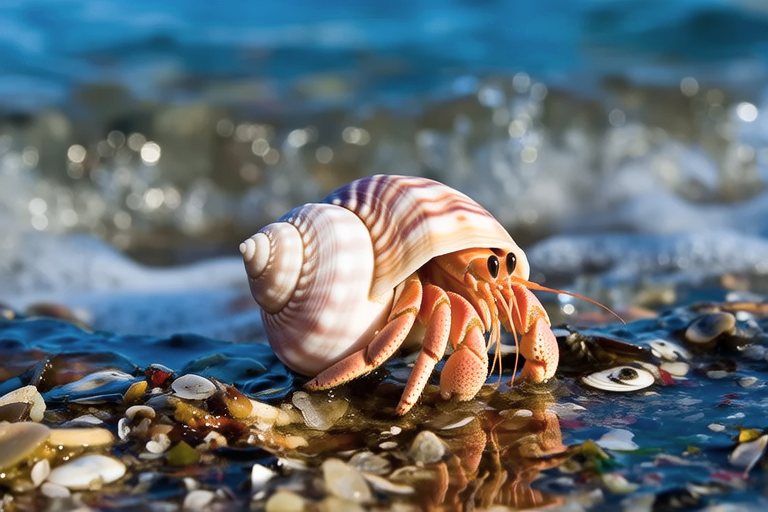
From Shell to Shore: A Journey Through the Life of a Hermit Crab
Welcome to the fascinating world of hermit crabs, one of the most intriguing creatures in the marine ecosystem. These small crustaceans have a unique lifestyle, primarily characterized by their reliance on second-hand shells for protection. Unlike other crabs that develop their own hard exoskeletons, hermit crabs inhabit empty mollusk shells, a behavior that has earned them their name. This article will guide you through the life cycle of hermit crabs, from their hatching as larvae to their growth into mature adults. We’ll explore their habitat, behaviors, and the challenges they face in securing suitable homes. By the end, you’ll understand why hermit crabs play a crucial role in maintaining marine biodiversity and why it’s important to protect them.
The Early Stages: From Egg to Juvenile
The journey of a hermit crab begins when the female lays thousands of tiny, transparent eggs. These eggs are attached to the underside of the mother’s abdomen, where they remain until they hatch. Once the eggs hatch, the larvae enter the water column as zoea, a free-swimming stage. Zoea larvae are incredibly vulnerable during this phase, drifting at the mercy of ocean currents. Over several weeks, they undergo multiple molts, gradually developing more complex body structures. Eventually, they reach the final larval stage, known as the megalops, which closely resembles a tiny adult hermit crab.
After several days or weeks, depending on the species and environmental conditions, the megalops settles onto the seafloor. Here, it undergoes its first molt and enters the juvenile stage. At this point, the young hermit crab faces one of its most significant challenges: finding its first shell. This initial shell must be just large enough to accommodate the growing crab while providing adequate protection. The search for a suitable shell can be perilous, as the young hermit crab may encounter predators or struggle to find a shell in areas with high competition.
The Quest for a Suitable Shell
Once a hermit crab finds its first home, it remains faithful to its chosen shell, but only for as long as it fits. As the hermit crab grows, it must periodically seek out larger shells to accommodate its expanding size. The process of selecting a new shell is both art and science. Hermit crabs carefully inspect potential homes, considering factors such as size, shape, weight, and even the shell’s color. They use their antennae and claws to assess the shell’s fit and stability before making a decision.
However, finding a suitable shell is no easy task. In many habitats, there is fierce competition for available shells, especially in areas with high hermit crab densities. Some hermit crabs may resort to stealing shells from others, leading to aggressive confrontations. In some cases, hermit crabs may even engage in a ritualized dance, tapping on each other’s shells to determine who gets to keep theirs. Despite these challenges, hermit crabs have developed remarkable strategies to ensure they always have a safe and comfortable home.
Habitats and Ecosystem Interactions
Hermit crabs can be found in a variety of marine environments, from shallow coastal waters to deep-sea habitats. They thrive in areas rich in detritus and organic matter, such as coral reefs, rocky shores, and mangrove forests. These environments provide ample food sources and hiding spots, making them ideal for hermit crabs. Their diet consists mainly of algae, decaying plant material, and small animals, and they play a vital role in breaking down organic matter, recycling nutrients, and contributing to the overall health of their ecosystems.
Hermit crabs also have complex social interactions within their communities. They often gather in groups, particularly around feeding sites or during shell exchanges. These gatherings can involve hundreds or even thousands of individuals, creating a bustling scene of activity. Additionally, hermit crabs have symbiotic relationships with certain species, such as sea anemones. By attaching anemones to their shells, hermit crabs gain additional protection from predators, while the anemones benefit from mobility and access to food.
Threats and Conservation Efforts
Despite their resilience and adaptability, hermit crabs face numerous threats to their survival. One of the most significant challenges comes from human activities, including pollution, habitat destruction, and overharvesting. Many species of hermit crabs are collected for the pet trade, leading to declines in wild populations. Additionally, climate change poses a threat to hermit crabs, as rising sea temperatures and ocean acidification can affect their ability to find suitable shells and reproduce successfully.
To address these issues, various conservation efforts are underway. Marine protected areas and sustainable fishing practices help preserve hermit crab habitats and reduce overharvesting. Education campaigns raise awareness about the importance of hermit crabs in marine ecosystems and encourage responsible behavior when interacting with these creatures. Furthermore, research into hermit crab biology and ecology provides valuable insights that can inform conservation strategies and management plans.
In conclusion, hermit crabs are fascinating creatures with a unique lifestyle that revolves around their dependence on shells for protection. From their hatching as larvae to their growth into mature adults, hermit crabs face numerous challenges in finding suitable homes and adapting to their ever-changing environments. Their contributions to marine biodiversity cannot be overstated, and it is essential to recognize the integral role they play in maintaining healthy ecosystems. By appreciating and protecting hermit crabs, we can help ensure the continued survival of these remarkable creatures for generations to come.
