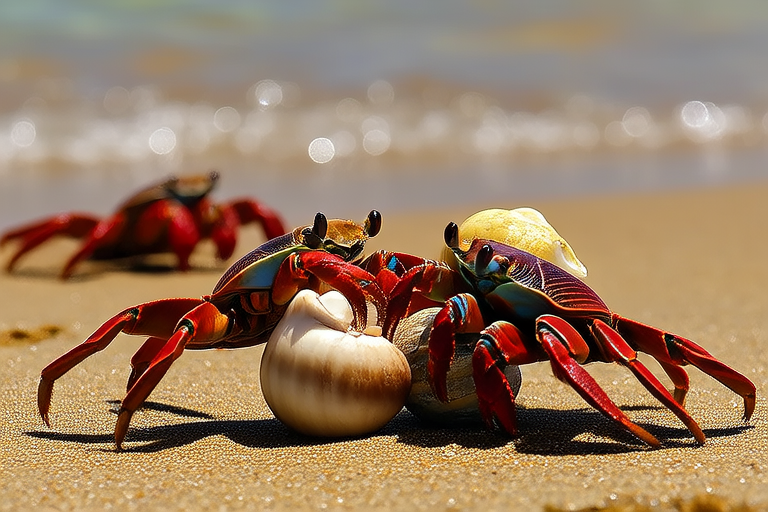
The Intricate Social Structures of Hermit Crabs: Tiny Titans of the Shell Swap
Hermit crabs, often referred to as Tiny Titans, are fascinating creatures known for their complex social structures. These small crustaceans, despite their solitary appearance, exhibit a range of communal behaviors, particularly when it comes to their shell-swapping rituals and interactions within their ecosystems. This article delves into the hierarchy, cooperation, and communication methods unique to hermit crab colonies, offering insights into their surprising social complexity.
Communal Behaviors: A Community of Shelter Seekers
Hermit crabs are best known for their reliance on secondhand shells for protection. Unlike other crustaceans that grow their own exoskeletons, hermit crabs must find and adapt discarded mollusk shells to suit their growing bodies. This necessity drives them to form tight-knit communities where sharing and exchanging resources are crucial. In these communities, hermit crabs engage in what is known as shell-swapping rituals. These rituals involve coordinated efforts to find and secure suitable shells, often leading to intricate social interactions.
Recent studies have shown that hermit crabs exhibit a remarkable level of cooperation during these shell exchanges. For instance, when a larger shell becomes available, multiple crabs may gather around it, each attempting to move into it. This behavior is not merely opportunistic but involves a series of coordinated movements and negotiations among the participants. Observations have revealed that smaller crabs will sometimes assist larger ones in moving into new shells, thereby ensuring their own access to better accommodations in the future. This cooperative behavior underscores the importance of communal living for hermit crabs.
Hierarchy and Leadership: The Dynamics of Shell Swapping
Within hermit crab colonies, there exists a subtle hierarchy that influences shell-swapping dynamics. Larger hermit crabs, due to their size and strength, often dominate the process of securing and exchanging shells. They tend to be more aggressive in defending their current shells and are more likely to initiate shell-swapping activities. Smaller crabs, while less dominant, play a crucial role in supporting these larger individuals by helping to move shells and creating opportunities for shell exchanges.
Leadership within these groups is fluid and context-dependent. During times of scarcity, larger crabs may take on more prominent roles, while in abundance, smaller crabs might lead the way in exploring new territories for better shells. This dynamic leadership structure ensures that the colony remains adaptable and resilient in the face of environmental changes.
Communication Methods: The Language of Tiny Titans
Hermit crabs communicate primarily through chemical signals, touch, and visual cues. Their primary mode of communication involves releasing pheromones, which can signal danger, readiness for mating, or the availability of a new shell. These chemical signals are particularly important during shell-swapping rituals, as they help coordinate group activities and ensure that all members are aware of potential threats or opportunities.
Touch also plays a significant role in hermit crab communication. When one crab touches another with its antennae, it can convey a variety of messages, from aggression to cooperation. Visual cues, such as the movement of other crabs, also influence behavior. For example, the sight of a crab moving into a new shell can prompt others to join in the activity.
Shell Swapping Rituals: A Complex Dance of Survival
The shell-swapping ritual is a central aspect of hermit crab life. It is a highly coordinated activity that requires precise timing and mutual cooperation. When a new shell becomes available, several crabs may gather around it, forming a line. The largest crab in the group will typically attempt to enter the shell first, followed by the next largest, and so on. This process can take several minutes, during which time the crabs are vulnerable to predators and environmental hazards.
Recent studies have highlighted the strategic nature of these shell-swapping events. Researchers have observed that hermit crabs often wait for optimal conditions before engaging in shell swaps. For instance, they are more likely to participate in shell exchanges during periods of low tide or when predator activity is minimal. This suggests that hermit crabs have evolved sophisticated mechanisms for assessing risk and timing their activities accordingly.
Challenges in Maintaining Social Structures
Despite their adaptive strategies, hermit crabs face numerous challenges in maintaining their social structures, especially in altered environments. Human activities, such as pollution and habitat destruction, have significantly impacted hermit crab populations. Pollution, particularly plastic debris, has led to an increase in non-biodegradable shells, which can harm hermit crabs. Additionally, the loss of natural habitats, such as coral reefs and mangrove forests, has reduced the availability of suitable shells.
Climate change poses another significant threat to hermit crab communities. Rising sea levels and increased storm frequency can disrupt shell-swapping activities and displace entire colonies. Moreover, warming ocean temperatures can affect the availability of food sources, further complicating the lives of these tiny titans.
Conclusion: The Resilience of Tiny Titans
Hermit crabs, with their intricate social structures and complex behaviors, continue to fascinate researchers and observers alike. Their communal behaviors, hierarchical organization, and cooperative shell-swapping rituals demonstrate a surprising level of social complexity. Despite facing numerous challenges in both natural and altered environments, hermit crabs have proven to be remarkably resilient. By understanding and appreciating the social dynamics of these tiny titans, we can better protect and conserve their habitats, ensuring the survival of these fascinating creatures for generations to come.
